Orion Advisor Tech is an all-in-one wealth platform that administers roughly $5.9 trillion in advisor-managed assets, and it ranked #1 for portfolio accounting, CRM and all-in-one software in the 2026 T3 advisor survey. The Omaha-based firm bundles portfolio accounting, Redtail CRM, trading, financial planning, compliance and a client portal into a single stack. It serves solo registered investment advisors, enterprise wealth firms, broker-dealers, banks and family offices. This review covers what Orion does well, where reviewers push back, and how to judge the quote you receive.
Orion is best understood as two connected businesses. One is Advisor Tech, the software layer that most firms mean when they say "we run on Orion." The other is a Wealth Management division that operates a turnkey asset management platform, or TAMP, plus outsourced chief investment officer services and custom indexing. Understanding that split matters, because the pricing and the sales conversation differ depending on which side you engage.
What Orion does
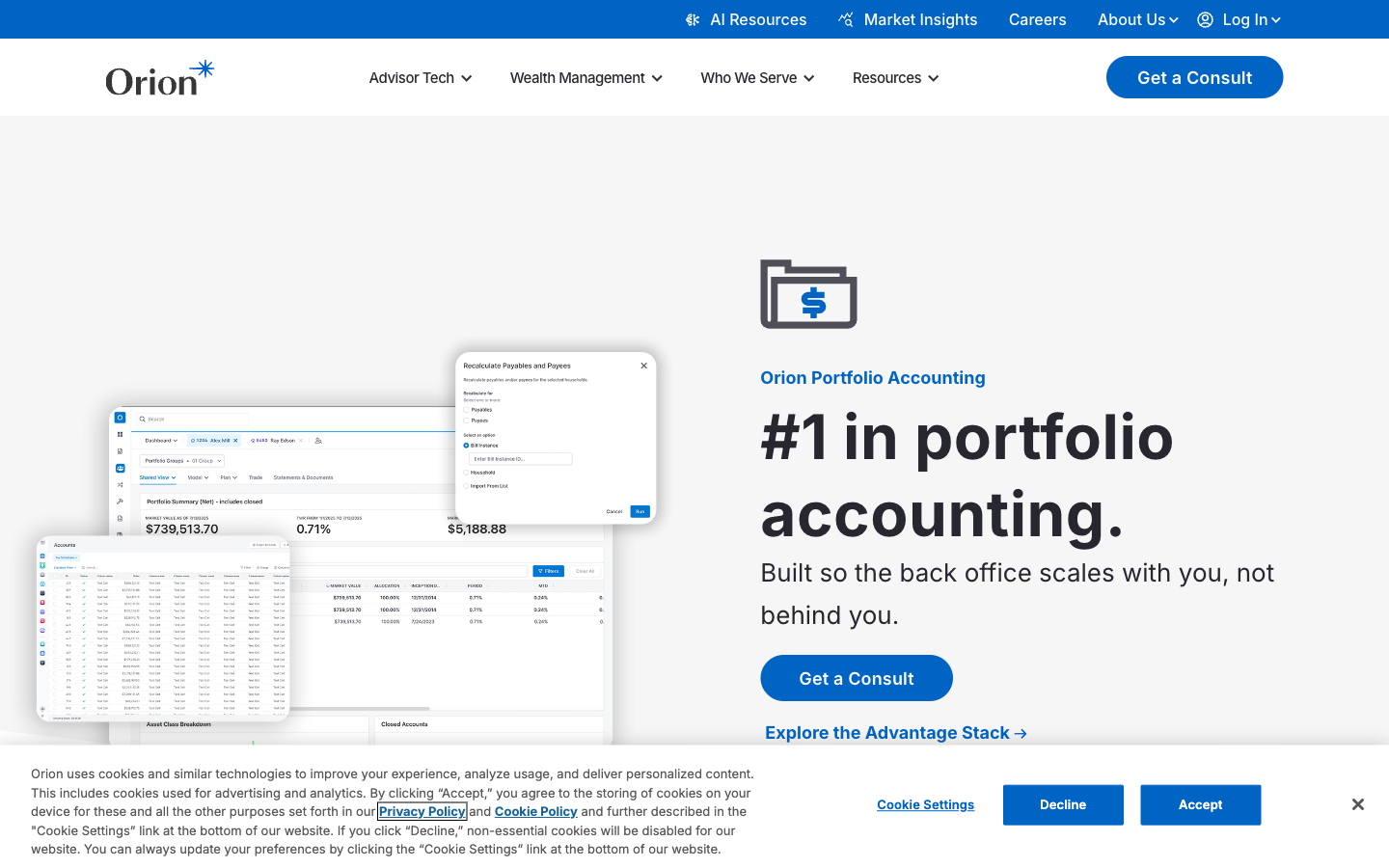
Orion positions portfolio accounting as its center of gravity. The platform reconciles positions directly from custodians, calculates performance, runs AUM fee billing and stores household-level data in a cloud warehouse. Orion cites T3 and The Kitces Report when it claims the #1 market-share position for both portfolio accounting and AUM fee billing. That claim, unlike its pricing, is backed by named third-party surveys.
The rest of the suite builds outward from that accounting core.
- Redtail CRM: the advisor CRM Orion acquired, used by more than 100,000 investment professionals
- Trading: household-level rebalancing, sleeve-based accounts and direct trade routing to multiple custodians
- Planning: goals-based planning that connects client objectives to reported performance
- Compliance and Risk Intelligence: exam-readiness tooling and portfolio risk analytics, the latter originating from Orion's HiddenLevers acquisition
- Client Portal and mobile app: the client-facing reporting layer
Because Orion owns each of these pieces rather than partnering for them, a firm can, in theory, consolidate its whole tech stack under one contract. That consolidation is the central pitch. It also raises the stakes if onboarding goes poorly, a point reviewers return to often.
Trading and tax management
Trading is where the platform shows real depth. It supports household-level rebalancing and, notably, daily tax-loss harvesting with per-client tax sensitivity and wash-sale controls. Advisors can blend direct indexing, third-party strategist models and Orion's own proprietary models inside a single household. Block trading includes pre-trade review steps.
For a firm that bills on assets and manages taxable accounts, tax-aware trading is not a nice-to-have. It typically drives measurable after-tax return differences over a full market cycle, which is why this module often anchors the buying decision.
Data and AI layer
Orion has invested in a data layer it calls Denali, along with an enterprise AI product built on top of it. The firm holds ISO/IEC 42001 certification for AI management, an unusual and specific credential to disclose. The general availability status and pricing of the AI features are not clearly published, so treat any AI capability as something to confirm live during a demo rather than assume.
Who Orion fits
Orion scales unusually wide. The portfolio accounting page describes serving practices from solo advisors up to firms managing tens of billions in assets, and the company states that 17 of the top 20 Barron's RIAs run on Orion. That enterprise credibility is real, though it cuts both ways.
Larger, growth-minded RIAs tend to get the most from the platform, because they can use the breadth. If you want a single vendor for accounting, CRM, trading, planning and compliance, and you have the operational staff to run a heavier system, Orion is a natural shortlist candidate. Smaller firms sometimes find the platform and its pricing heavier than they need.
Already running Redtail CRM? Then Orion deserves a close look, since the CRM you use is already part of its ecosystem.
The audience question connects directly to cost, because Orion's quote depends on exactly how much of the platform you switch on.
Orion pricing
Here honesty matters more than precision. Orion does not publish pricing on its own website. Every product page reviewed states the same thing: pricing is based on firm size, AUM and configuration, and you must contact Orion for a tailored quote.
Third-party sites circulate figures for Orion's bundled "Stacks," commonly listing a Foundation tier near $13,000 a year, an Essentials tier near $18,000 and an Advantage tier near $28,000, plus per-user add-ons such as Risk Intelligence. None of these numbers appear on Orion.com, and they should be treated as unverified third-party estimates rather than official rates. When you request a quote, ask for the all-in annual figure including implementation, because migration effort is where Orion engagements can grow.
The pricing model is quote-only, which is common among enterprise wealth platforms. It does make apples-to-apples comparison harder, so a written scope tied to your account count and module list is worth insisting on.
Integrations and ecosystem
Where pricing is opaque, Orion's connectivity is well documented. The platform lists 100+ integration partners and names several directly, including BlackRock, BNY Mellon Pershing, eMoney, Fidelity, MoneyGuide, Morningstar and Salesforce. Custodial connectivity covers the major three, Schwab, Fidelity and Pershing.
That breadth means Orion rarely becomes the reason a firm cannot use a favored planning or research tool. Even so, because Orion sells competing modules of its own, some overlap is inevitable. A firm running both Orion Planning and a rival planning tool, for example, should decide which system owns the client record, or risk maintaining two.
Strengths and drawbacks
No platform this broad earns universal praise, and Orion's reviews reflect genuine tension between capability and complexity.
On the strengths side, Orion pairs the leading portfolio accounting engine with an owned CRM and deep tax-aware trading. Its integration list is long, its enterprise references are strong, and its ISO 42001 AI certification signals a serious data posture.
The drawbacks cluster around rollout and the client experience. On G2, Orion holds roughly 4.4 out of 5 across 98 reviews, though a separate summary cited 4.3 across a larger count, so confirm the live figure before quoting it. Reviewers describe onboarding as inconsistent, with one calling data migration a "6-month process that stressed many people." Others say clients find the portal layout clunky and hard to customize. These are not fatal flaws, but they argue for a carefully scoped implementation plan and reference calls with firms your size.
Verdict
Orion is a top-tier all-in-one platform for advisory firms that want one vendor across accounting, CRM, trading and planning, and it earns an 8.6 out of 10 on the strength of its accounting engine, tax-aware trading and integration depth. The main reservations are practical rather than functional: budget for a real implementation, get pricing in writing, and talk to reference clients about the portal. Firms already on Redtail have the clearest path, since they are partway into the ecosystem already.
To weigh Orion against other suites, compare it on our vendor matrix or read our portfolio management software hub. Advisors evaluating a full stack switch should request a scoped demo before committing.
This review reflects information published on Orion's official site and third-party review platforms as of July 2026. It is editorial analysis, not financial or investment advice. Pricing and product details change; confirm current terms directly with the vendor.
Frequently asked questions
Who is Orion built for?
Orion serves solo RIAs through enterprise wealth firms, broker-dealers, banks and family offices. The platform notes clients ranging from single-advisor practices to firms managing tens of billions in assets.
Who is Orion built for?
Orion serves solo RIAs through enterprise wealth firms, broker-dealers, banks and family offices. The platform notes clients ranging from single-advisor practices to firms managing tens of billions in assets.
Who is Orion built for?
Orion serves solo RIAs through enterprise wealth firms, broker-dealers, banks and family offices. The platform notes clients ranging from single-advisor practices to firms managing tens of billions in assets.
Book a Orion demo
Vendor-facilitated. We forward your request to their sales team within 24 hours.
- Choose a preferred date + time slot
- 30-minute product walkthrough
- Custom pricing based on your seat count
Screenshots
Pros
- Ranked #1 for portfolio accounting and AUM fee billing in the 2026 T3 advisor software survey
- Owns Redtail CRM, so CRM, accounting, trading and planning sit under one vendor
- Daily tax-loss harvesting with household-level, tax-sensitive rebalancing
- 100+ integrations plus direct connectivity to Schwab, Fidelity and Pershing
Cons
- No published pricing; quotes depend on AUM, users and modules
- G2 reviewers describe onboarding and data migration as heavy and slow
- Client portal layout and customization draw recurring criticism
Similar Wealth Management Software Tools
User Reviews
Write a reviewNo reviews yet for Orion.
Be the first to review