eMoney Advisor is a financial planning platform that combines goals-based and cash-flow planning, used by more than 109,000 financial professionals serving over 6 million households. Founded by advisors in 2000 and owned by Fidelity Investments since 2015, it serves independent advisors through large enterprise financial organizations. This review covers eMoney's planning depth, its well-known client portal, the pricing questions buyers face, and where it fits against lighter rivals.
eMoney occupies a specific place in the planning market. Where some tools pick a side between goals-based and cash-flow methodologies, eMoney's flagship tier offers both. That breadth is the reason many established planning-focused firms standardize on it, and also the reason newer advisors sometimes find it heavier than they expected.
What eMoney does
eMoney sells four named tiers, each aimed at a different depth of planning relationship. The lineup scales from streamlined goals-based planning up to an enterprise platform with APIs and custom client experiences.
- eMoney Plus: streamlined, goals-based planning for building more planning relationships
- eMoney Pro: comprehensive cash-flow planning for complex client needs
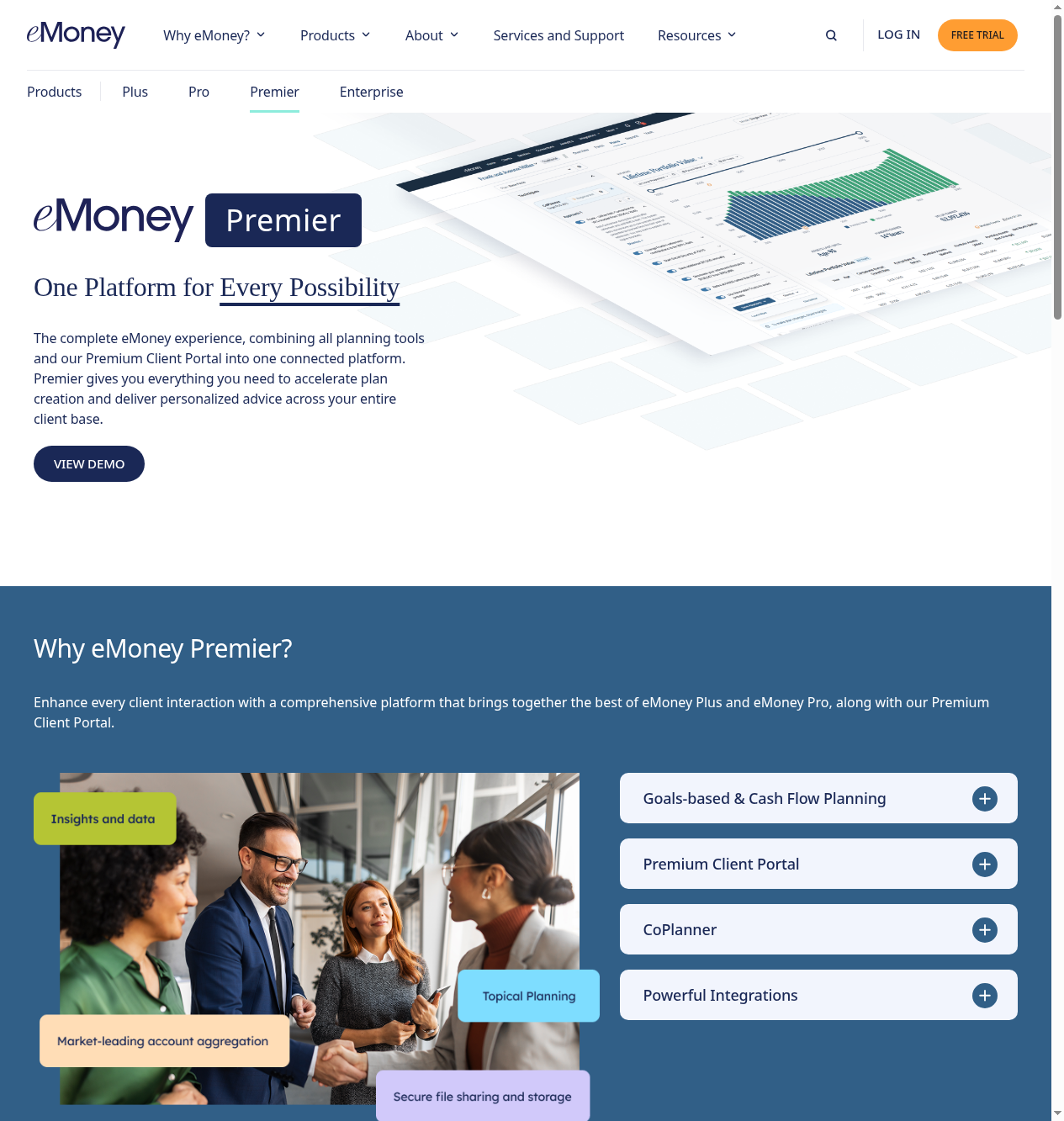
- eMoney Premier: both methodologies in a single platform, marked as recommended
- eMoney Enterprise: scalable, customizable planning for large financial organizations
Across the tiers, the platform offers Monte Carlo analysis, account aggregation, a client portal with round-the-clock access, and the Decision Center for collaborative what-if modeling.
Planning depth
Planning is eMoney's core, and the Premier tier shows why. It combines goals-based and comprehensive cash-flow planning, letting an advisor serve simple and complex clients on one platform. The Decision Center, marketed as a powerful collaborative planning tool, lets advisor and client model scenarios together and see how each decision reshapes the plan.
The CoPlanner feature aims to speed plan creation, with the company citing plans built up to 48% faster through automated insights. For firms delivering many plans, that throughput matters. Estate-planning and insurance capabilities were not named as distinct branded modules on the pages reviewed, so confirm exactly how those needs are handled if they are central to your practice.
Client portal and aggregation
Beyond the planning engine itself, the client portal is one of eMoney's most recognized strengths. It gives clients a full financial picture with progress tracking and spending monitoring, backed by account aggregation and mobile access. A strong portal drives client engagement, which is often the point of buying planning software in the first place.
That said, aggregation is also a recurring pain point. Reviewers report connection issues with banks and brokerages and frequent re-authentication after institutions change password rules. Test aggregation against your clients' actual institutions before committing.
Who eMoney fits
eMoney fits planning-focused advisors and firms that want depth across both goals-based and cash-flow methodologies, scaling up to enterprise deployments at banks and broker-dealers. Its 109,000-professional user base spans firms of all sizes.
The trade-off is complexity and cost. Reviewers describe a steep learning curve and terminology that can overwhelm newcomers, and note that getting all the features is pricey. Advisors who want lightweight, fast planning for mainstream clients sometimes find a simpler tool a better daily fit.
When comprehensive cash-flow planning and a best-in-class client portal are central to your value proposition, eMoney is a natural fit. If you want speed and simplicity, weigh a lighter alternative.
That fit question runs straight into eMoney's pricing, which the company keeps private.
eMoney pricing
eMoney does not publish pricing. Cost is quote-based and varies by tier, user count and add-ons. One review source also notes an inflexible 12-month contract, which is worth factoring into any decision.
Third-party estimates circulate for the tiers, but they are unverified secondhand figures and should not be treated as official rates. Because the contract is annual, model the full-year commitment and confirm exactly which features your tier includes before signing.
Integrations and ecosystem
Where pricing is opaque, integrations are well documented. eMoney lists more than 30 partners spanning CRMs, portfolio, risk and aggregation tools.
Named partners include Redtail, Wealthbox, Orion, Black Diamond, Envestnet Tamarac, MoneyGuide, Morningstar, Nitrogen, Addepar, Advyzon, Schwab and Fidelity, among others. The Enterprise tier additionally exposes APIs and aggregation for custom builds. That breadth means eMoney fits comfortably into most advisor tech stacks, and its Fidelity ownership adds ecosystem weight.
Strengths and drawbacks
eMoney's profile is that of a mature, deep planning platform, with the complexity that depth brings.
Its strengths are dual-methodology planning, a strong client portal, broad integrations and the backing of Fidelity. The company cites its own ROI study in which most surveyed advisors reported improved client engagement and efficiency, though that is a vendor-run study and should be read as such.
The drawbacks are consistent across independent reviews: a steep learning curve, aggregation connectivity issues, higher cost to unlock full functionality, and the inflexible annual contract. No specific security certification appeared on the pages reviewed, so verify the security posture directly if that matters to your firm.
Verdict
eMoney earns an 8.3 out of 10 as a deep, dual-methodology planning platform for firms that make planning and client engagement central to their value. Its planning breadth and client portal are genuine strengths, backed by scale and Fidelity ownership. The reservations are the learning curve, aggregation reliability and opaque annual pricing. Trial the platform, test aggregation against your clients' institutions, and get pricing and contract terms in writing.
Compare eMoney with other planning tools on our vendor matrix, or explore the financial planning software hub.
This review reflects information published on eMoney's official site and third-party review platforms as of July 2026. It is editorial analysis, not financial or investment advice. Confirm current pricing, contract terms and product details directly with the vendor.
Frequently asked questions
Who owns eMoney?
Fidelity Investments acquired eMoney in 2015. The company was founded by advisors in June 2000 and has more than tripled in size since the acquisition.
Who owns eMoney?
Fidelity Investments acquired eMoney in 2015. The company was founded by advisors in June 2000 and has more than tripled in size since the acquisition.
Who owns eMoney?
Fidelity Investments acquired eMoney in 2015. The company was founded by advisors in June 2000 and has more than tripled in size since the acquisition.
Book a eMoney Advisor demo
Vendor-facilitated. We forward your request to their sales team within 24 hours.
- Choose a preferred date + time slot
- 30-minute product walkthrough
- Custom pricing based on your seat count
Screenshots
Pros
- Combines goals-based and comprehensive cash-flow planning in one platform
- Well-regarded client portal with account aggregation and interactive tools
- Used by 109,000+ financial professionals serving 6 million+ households
- 30+ integrations across CRMs, portfolio and risk tools; Fidelity-owned
Cons
- No published pricing and a reportedly inflexible 12-month contract
- Steep learning curve; less intuitive than some planning rivals
- Recurring account-aggregation connectivity complaints
Similar Financial Planning Software Tools
User Reviews
Write a reviewNo reviews yet for eMoney Advisor.
Be the first to review